Shadows of the Algorithm: Mapping Narrative Branching Patterns in Emerging Indie Horror Titles
Yara Simmons · May 16, 2026
Shadows of the Algorithm: Mapping Narrative Branching Patterns in Emerging Indie Horror Titles
Indie horror developers have turned to algorithmic systems that map narrative branches with increasing precision, and these tools allow stories to shift based on player input while preserving core atmospheric tension across multiple routes. Emerging titles released through 2025 and into May 2026 demonstrate how small teams integrate decision trees with procedural elements that respond to choices in real time, creating experiences where the same sequence of events rarely repeats exactly. Data from industry tracking services shows that narrative-driven horror projects now account for over 30 percent of new indie releases on platforms such as Steam and itch.io, with branching complexity cited as a primary development focus.
Core Structures Behind Branching Horror Narratives
Branching patterns in these games typically rely on weighted decision graphs where each node represents a story state and edges carry probability values that adjust according to prior selections. Researchers at institutions including the University of California, Santa Cruz have documented how developers assign conditional triggers to events such as character survival or environmental changes, and these triggers feed into algorithms that prune low-probability paths to avoid narrative bloat. The result appears in titles where one playthrough might emphasize psychological isolation while another surfaces hidden lore through altered dialogue trees, yet both maintain consistent horror pacing through shared environmental cues.
Algorithms often incorporate memory variables that track cumulative player behavior across sessions, and this data influences later branches without requiring explicit flags. Observers note that such systems reduce the need for exhaustive manual scripting, allowing teams with limited resources to generate dozens of viable endings from a core set of scenes. In practice the mapping process begins with a central spine of mandatory events that anchor the horror atmosphere, after which side branches diverge and reconverge at key tension points.
Patterns Observed in Recent Releases
Analysis of titles launched between late 2025 and May 2026 reveals recurring motifs in how branches handle player agency. One common structure clusters choices around moral ambiguity rather than binary outcomes, so selecting to investigate a sound or ignore it produces ripple effects that surface only hours later. Another pattern uses time-based decay on certain variables, meaning early decisions lose influence unless reinforced, which forces players to commit to paths under pressure. Industry reports compiled by the Entertainment Software Association indicate that horror games employing these layered systems retain players for an average of 2.4 additional hours compared with linear counterparts.
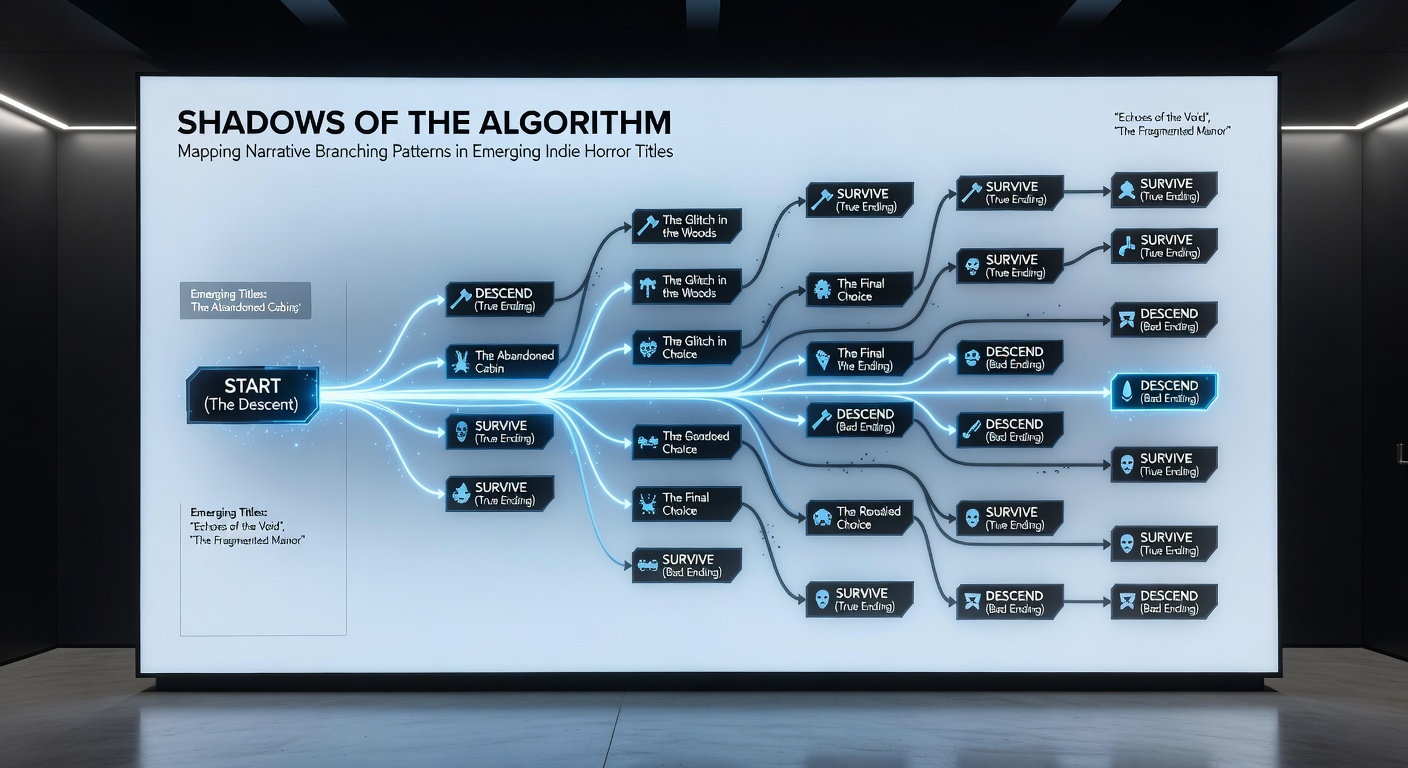
Developers frequently employ visualization tools during preproduction to chart these maps, and the resulting diagrams resemble decision lattices rather than simple flowcharts. Each lattice includes feedback loops where repeated behaviors unlock variant scenes, yet the loops remain invisible to players until triggered. Those who have studied the code repositories of open-source horror frameworks report that random seed injection at branch points prevents identical replays even when the same choices occur, adding replay value without additional art assets.
Technical Implementation and Data Flow
Behind the scenes the algorithmic layer processes input through state machines that query databases of narrative fragments, and each fragment carries metadata tags for tone, duration, and prerequisite conditions. When a player reaches a decision node the system evaluates active tags against stored weights before selecting and rendering the next segment. This flow allows seamless integration of procedural audio cues or lighting shifts that reinforce the chosen branch while preserving overall coherence. Figures from academic surveys conducted across European game labs show that teams using modular fragment systems cut scripting time by approximately 40 percent compared with traditional linear scripting methods.
Cross-platform releases further complicate mapping because input latency and save-state synchronization must align across devices, yet several 2026 titles have demonstrated stable performance through cloud-assisted state tracking. The algorithms reconcile discrepancies by prioritizing the most recent local decision log, which prevents narrative drift during handoffs between PC and handheld play.
Conclusion
Mapping narrative branching patterns through algorithmic systems continues to define a growing segment of indie horror development, and the techniques refined in 2025 and early 2026 provide scalable frameworks that balance player freedom with atmospheric consistency. As new titles appear the underlying data structures evolve toward greater adaptability, supported by ongoing research from universities and industry groups that track implementation metrics across regions. These patterns ultimately shape how horror stories unfold in interactive formats without relying on exhaustive manual design.