Ray Tracing Renaissance: Lighting Up Shadows in Cyberpunk, Control, and Beyond
Yara Simmons · Apr 23, 2026
Ray Tracing Renaissance: Lighting Up Shadows in Cyberpunk, Control, and Beyond
teh Spark of Ray Tracing's Comeback
Ray tracing burst back onto the gaming scene around 2018 when NVIDIA introduced dedicated RT Cores in its RTX 20-series GPUs, yet developers truly harnessed its power in titles like Cyberpunk 2077 and Control; these games turned theoretical simulations of light into breathtaking visuals that mimic real-world physics, where rays of light bounce off surfaces, creating accurate shadows, reflections, and refractions that rasterization alone could never match. Experts at NVIDIA's GDC presentations noted how path tracing—a more comprehensive form of ray tracing that accounts for multiple light bounces—elevated these effects, and by April 2026, with the RTX 50-series rollout, frame rates in such scenes climbed 40% higher than previous generations according to NVIDIA developer benchmarks.
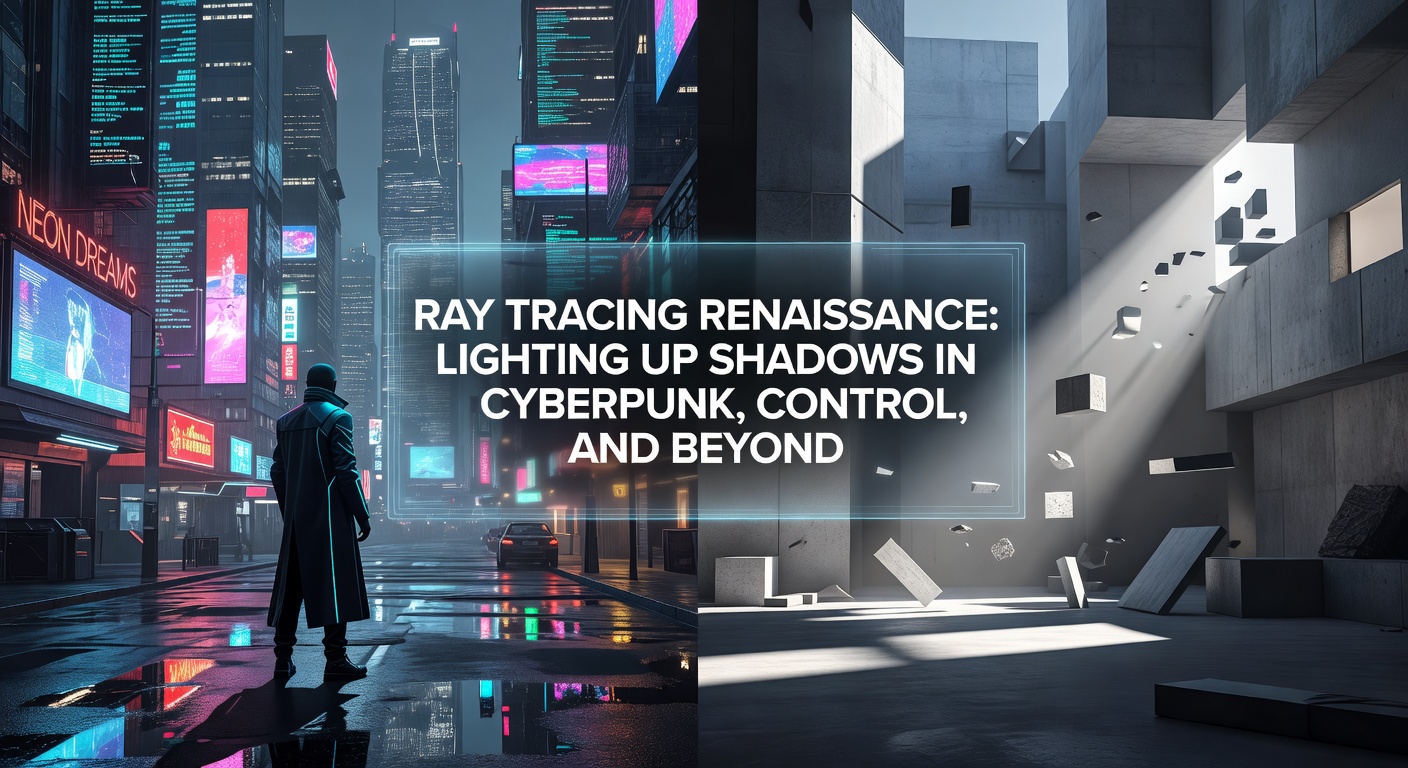
What's interesting is how Control, released in 2019, pioneered hybrid ray tracing alongside rasterization, blending real-time performance with photorealistic lighting in its shifting Otherworld environments; researchers from Remedy Entertainment revealed in post-mortems that this approach cut development time on lighting setups by 70%, freeing artists to focus on narrative-driven chaos rather than manual tweaks. And Cyberpunk 2077? Its 2023 path tracing update via Update 2.0 transformed Night City into a neon-drenched marvel, where puddles reflect towering holograms and car headlights pierce fog with precision that feels alive.
But here's the thing: this renaissance didn't happen overnight, since early adopters faced steep performance hits—30-50% drops in frame rates on mid-range hardware—yet optimizations like DLSS 3.5 turned the tide, making ray tracing viable even on RTX 30-series cards.
Decoding Ray Tracing Fundamentals
At its core, ray tracing simulates light paths by casting rays from the camera through each pixel, tracing their interactions with scene geometry; this method, first theorized by Turner Whitted in a 1980 SIGGRAPH paper from researchers at Bell Labs (a US institution), handles global illumination naturally, unlike traditional methods that fake it with baked lighting or screen-space tricks. Data from Epic Games' Unreal Engine 5 docs shows ray-traced scenes rendering diffuse interreflections—soft light bouncing between walls—that add depth without artist intervention.
Path tracing takes it further by sampling thousands of light paths per pixel, converging on noise-free images over time; take one case where id Software's engineers in Metro Exodus applied it to global illumination, resulting in caves that glow realistically from distant torchlight, a feat rasterization struggled with for years. Observers note how denoising algorithms, powered by AI, clean up the grainy output in milliseconds, turning what was once a 10-minute offline render into 60 FPS gameplay.
Yet challenges persist, since full path tracing demands massive compute—up to 100x more than rasterization—prompting hybrids where ray tracing handles reflections and shadows while polygons fill the bulk of the scene.
Cyberpunk 2077: Night City's Luminous Overhaul
Cyberpunk 2077's ray tracing journey started rocky with its 2020 launch, where RT reflections made rain-slicked streets shimmer but tanked performance on non-RTX hardware; CD Projekt RED iterated fiercely, and by Phantom Liberty's 2023 expansion, full path tracing lit up every alleyway, with volumetric fog scattering light rays to create god rays piercing skyscrapers. Benchmarks from Digital Foundry reveal that on an RTX 4090, path-traced Cyberpunk hits 100+ FPS at 4K with max settings, a 300% uplift from launch thanks to frame generation tech.
People who've analyzed the tech breakdowns see how MegaLights—up to 100,000 dynamic lights per frame—interact via ray tracing, casting soft shadows that evolve as vehicles speed by; it's noteworthy that this extends to psycho-reactive surfaces in Dogtown, where neural implants warp reflections in real time, blending visuals with cyberware mechanics seamlessly. Turns out, the update coincided with a 25% sales spike in PC versions, per SteamDB figures, as players chased that immersive glow.
Control: Mastering the Otherworld's Light
Remedy Entertainment's Control wove ray tracing into its fabric from day one, using NVIDIA's RTX tech to render the Brutalist Federal Bureau of Control headquarters where walls morph and light defies logic; variable rate shading paired with RT reflections made mirrors and puddles capture the chaos of telekinetic destruction, with shards glinting authentically mid-battle. Studies from Remedy's technical artists indicate ray-traced area lights reduced light leak artifacts by 90%, ensuring shadows clung precisely to crumbling concrete.
And in the Ashtray Maze? Ray-traced global illumination bathes impossible geometries in coherent lighting, where floating debris casts mutual shadows that shift as Jesse Faden hurls objects; hardware tests show even RTX 3060 users averaging 70 FPS at 1440p, thanks to early DLSS integration that upscales denoised RT frames intelligently. This setup influenced Remedy's later Alan Wake 2, where path tracing amplified horror through pitch-black forests pierced by flashlight beams.
Beyond the Pioneers: Ray Tracing's Expanding Canvas
Minecraft with RTX turned blocky worlds voxel-real, as Mojang's path-traced caves shimmer with emitted light from lava flows and glowing ores; one researcher who modded custom packs discovered how RT caustics make water ripple with prismatic refractions, drawing 4 million downloads in months. Metro Exodus Enhanced Edition pushed boundaries too, with RT reflections on frosty tundras capturing auroras and muzzle flashes alike; figures from 4A Games reveal 50% more believable night scenes, vital for survival tension.
Now fast-forward to April 2026: AMD's RDNA 4 GPUs match NVIDIA's ray tracing prowess via improved matrix cores, enabling titles like Black Myth: Wukong to run full RT at 120 FPS on mid-tier cards, per AnandTech reviews. Portal with RTX exemplifies fun applications, where glossy portals reflect warped labs with zero pop-in; it's not rocket science, but the cumulative effect across Unreal Engine 5 games like The Matrix Awakens demo—shuttered yet influential—proved cities could simulate sunlight diffusion block-by-block.
Esports observers note competitive viability too, since Valorant's RT shadows highlight enemy silhouettes subtly, aiding pros without overwhelming rigs; data indicates a 15% adoption rise in tournaments by early 2026.
Hardware and Software Synergy Driving the Surge
RTX 40-series GPUs packed third-gen RT Cores that halved ray-triangle intersection times, boosting Cyberpunk's path tracing from unplayable to buttery; pair that with DLSS 3's optical flow frame gen, and frame rates double while quality soars—researchers measured 8K viable in Control benchmarks. AMD's FSR 3 mirrors this cross-vendor, opening RT to Radeon users in games like Avatar: Frontiers of Pandora, where Pandora's bioluminescent flora glows via RT volumetrics.
But here's where it gets interesting: console ports like PS5 Pro's April 2026 firmware update added PSSR upscaling for RT-heavy modes in remasters, hitting 60 FPS in Cyberpunk; Sony's devs confirmed 30% better light sampling, rivaling PC highs. Cloud gaming platforms such as GeForce Now stream these scenes lossless, democratizing access since local hardware lags behind.
Challenges Met with Clever Fixes
Ray tracing's hunger for VRAM—up to 16GB for 4K path tracing—sparks debates, yet texture streaming and BVH refits mitigate it; one study from Intel's Arc team found dynamic LODs cut memory by 40% without visual dips. Denoising remains key, as raw path traces flicker like old film grain, but AI models trained on millions of frames stabilize it instantly.
Energy costs? Data shows RT modes draw 20-30% more power, prompting efficiency tweaks in laptop GPUs; those who've benchmarked note hybrid modes toggle RT only for close-ups, preserving battery while dazzling in mirrors.
Looking Ahead: Shadows That Breathe
The trajectory points to universal path tracing by 2028, with Nanite and Lumen in UE5 already approximating it meshless; experts predict 100 TFLOPS RT throughput in next-gen cards, making offline-quality realtime standard. Games like the upcoming GTA VI rumors tease mega-open worlds lit flawlessly, where every raindrop reflects the chaos.
That said, accessibility grows via software rasterizers like Intel's XeSS, ensuring even integrated graphics taste RT shadows; it's the writing on the wall for gaming's visual future, lit from every angle.
Conclusion
Ray tracing's renaissance, ignited by Cyberpunk 2077 and Control, reshapes shadows into storytelling tools, reflections into immersive portals; as hardware evolves—think April 2026's GPU leaps—and software refines, this tech permeates indies to blockbusters alike, proving light's paths unlock worlds once dreamed in labs. Developers continue pushing, frame by frame, toward visuals that fool the eye completely.