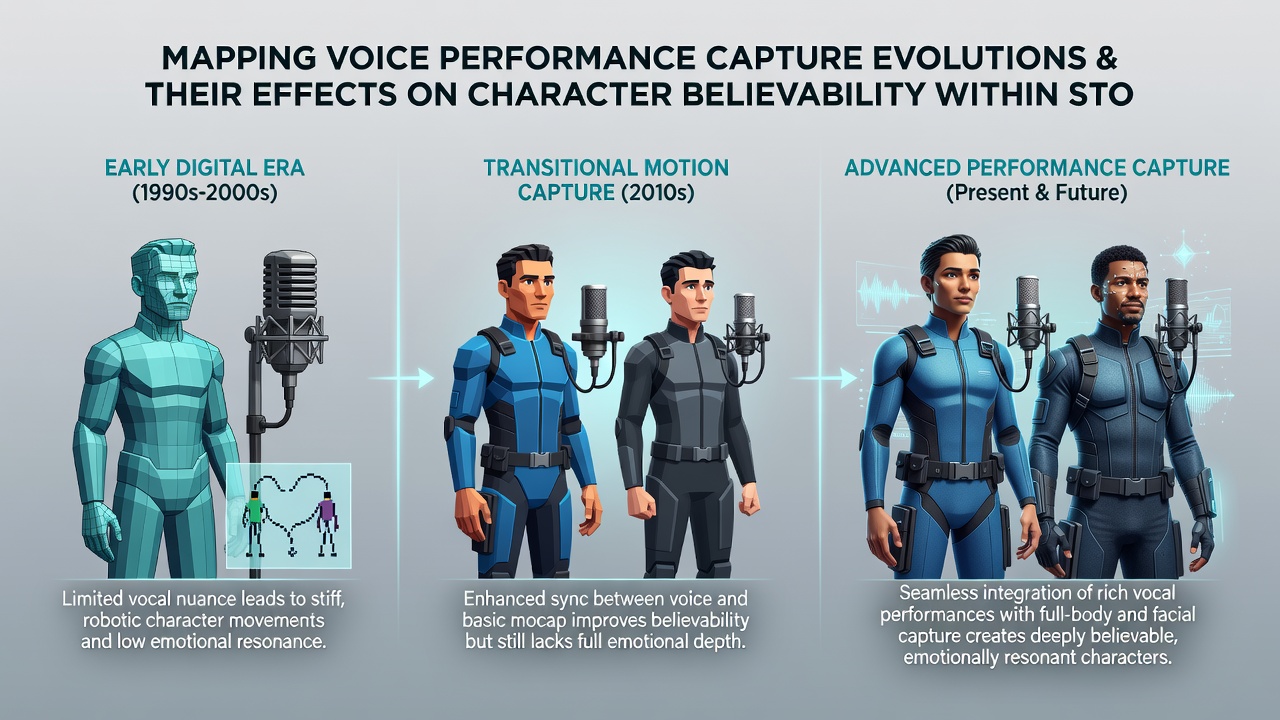
Mapping Voice Performance Capture Evolutions and Their Effects on Character Believability Within Story-Rich Role-Playing Experiences
Ellis Beck · Jun 9, 2026
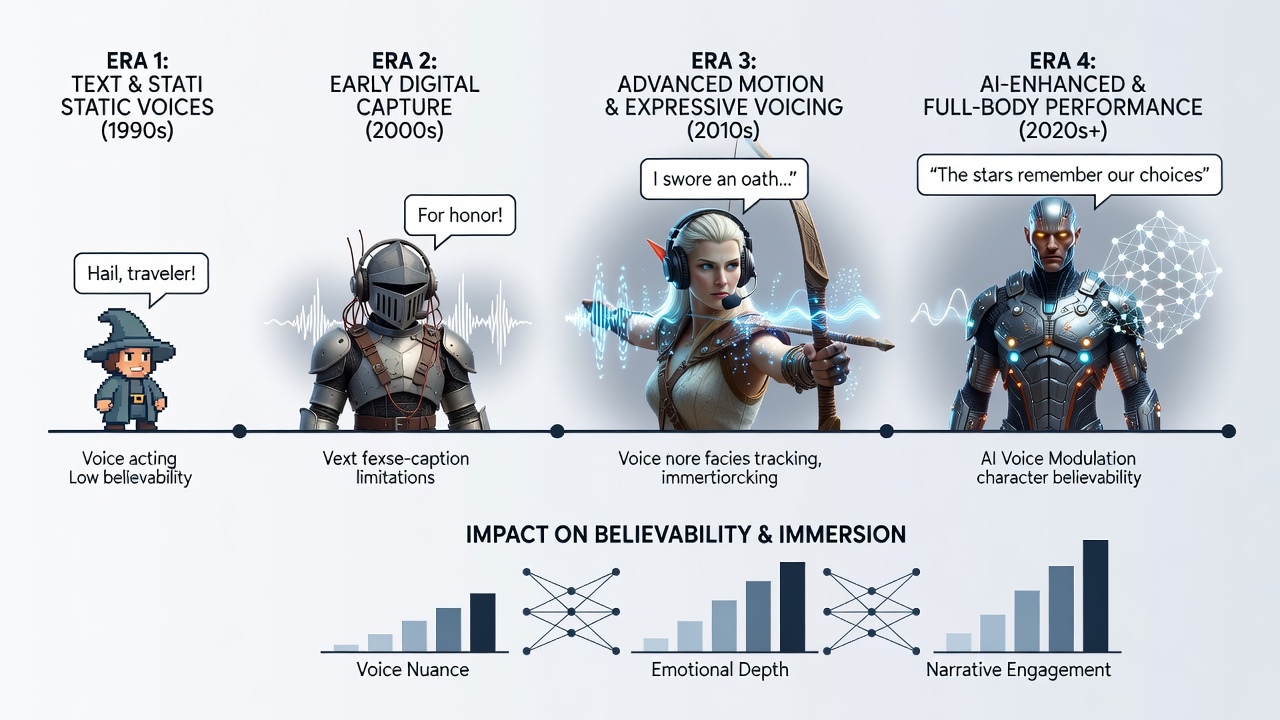
Mapping Voice Performance Capture Evolutions and Their Effects on Character Believability Within Story-Rich Role-Playing Experiences
Voice performance capture has progressed through multiple technological stages since the early 2000s, moving from isolated audio recordings to integrated systems that synchronize vocal delivery with facial animations and subtle body movements. Developers in story-rich role-playing experiences rely on these systems to align dialogue timing with character expressions, creating sequences where emotional shifts register through micro-movements around the eyes and mouth. Research from university labs indicates that these layered capture methods reduce the disconnect between spoken lines and visual cues that once appeared in earlier titles. Early implementations focused primarily on clean audio capture in controlled studio environments, with animators manually adjusting lip-sync frames afterward. Teams working on narrative-heavy projects discovered that this post-production approach limited the range of emotional delivery, since actors performed without real-time feedback on how their expressions would translate to digital models. Data collected during that period showed higher rates of player-reported detachment during extended dialogue scenes. Subsequent advancements incorporated optical marker systems and depth sensors that tracked facial landmarks during live performances. These tools allowed directors to capture multiple takes while monitoring how pitch variations and breathing patterns influenced muscle contractions on the digital face. Industry reports from the Entertainment Software Association note that adoption of such equipment expanded significantly between 2015 and 2020, coinciding with increased budgets allocated to character-driven RPGs.Integration of Real-Time Feedback Loops
Modern pipelines now include real-time rendering previews that let voice actors see their captured performance mapped onto the character model during the session. This immediate visual loop enables adjustments to intonation or pacing based on how the digital face responds, rather than relying solely on later editing passes. Engineers have refined algorithms that map phoneme data to blend shapes with greater precision, handling regional accents and emotional inflections that previously required extensive manual cleanup. Performance capture sessions for larger casts often span several weeks, with actors wearing head-mounted cameras alongside body suits to record simultaneous voice and gesture data. The resulting datasets feed into machine learning models trained on thousands of hours of recorded speech, improving the system's ability to predict natural head tilts and eyelid movements that accompany certain vocal stresses. Observers note that these models perform best when the training data includes diverse speaker demographics, reducing artifacts that break immersion during quiet conversational moments.Effects on Character Believability Metrics
Studies measuring player engagement in narrative RPGs have tracked how performance capture quality correlates with retention during dialogue-heavy sections. Figures from controlled experiments reveal that characters using full performance data maintain higher attention spans compared to those built from audio-only sources, particularly when scenes involve conflict or vulnerability. The synchronization of voice timbre with corresponding facial tension produces responses that align more closely with real-world social cues. Developers have also documented cases where incomplete capture data leads to noticeable stiffness during rapid emotional transitions, prompting players to disengage from the story thread. Refinements in capture resolution have addressed many of these issues by increasing the density of tracked points around the mouth and brow regions. This technical improvement allows for smoother interpolation between expressions without introducing the floating or sliding artifacts common in earlier generations.