Decoding Achievement Hunting Patterns and Their Correlation with Playtime Metrics in Expansive Digital Worlds
Yara Simmons · Jul 28, 2026

Decoding Achievement Hunting Patterns and Their Correlation with Playtime Metrics in Expansive Digital Worlds
Expansive digital worlds such as massive multiplayer online titles and open-ended role-playing environments generate extensive datasets that track both achievement completions and total hours spent by participants, and researchers continue to examine how these two metrics intersect across platforms. Data from industry reports released in early 2026 show that players who pursue full achievement lists often extend their sessions well beyond initial campaign completion points, creating measurable extensions in overall engagement curves. Observers note that these patterns emerge consistently in titles built around procedural generation and persistent online communities, where hidden objectives encourage repeated exploration loops.
Studies compiled by the Entertainment Software Association indicate that average playtime in large-scale worlds rises by measurable percentages when achievement systems incorporate layered requirements, including exploration milestones, collection tasks, and multiplayer coordination challenges. Those who've analyzed server logs from titles released between 2023 and 2025 find that participants who unlock at least seventy percent of available achievements spend roughly forty percent more time in-world compared to those who focus solely on story progression. Such figures reveal clear statistical ties without implying causation in every case.
Mapping Common Hunting Behaviors Across Platforms
Players in these environments often follow predictable sequences when tackling achievement lists, beginning with visible story-related objectives before shifting toward obscure side content that requires specific conditions or timing. In July 2026, telemetry from several major releases demonstrated that mobile and console versions of the same expansive worlds produce nearly identical progression curves once adjusted for input method differences. Analysts tracking these sequences point out that completionists frequently return to earlier zones after reaching endgame thresholds, revisiting areas for missed collectibles or rare encounters.
One pattern documented across multiple titles involves grouping achievements into thematic clusters, such as environmental mastery or social interaction goals, which allows hunters to optimize routes through vast maps. Research from academic groups in Canada has quantified how these clustered approaches reduce backtracking time while still increasing total logged hours due to the precision required for rare triggers. Data shows that participants who adopt route-planning tools integrated into community wikis complete more achievements per hour yet maintain longer cumulative play sessions overall.
Statistical Correlations with Total Playtime
Correlation coefficients calculated from anonymized player data across expansive worlds frequently land between 0.65 and 0.82 when comparing achievement density against total hours, according to aggregated findings presented at European gaming research conferences. These numbers hold across different genres provided the digital space offers sufficient scale for hidden objectives to exist. What's interesting is how the correlation strengthens in worlds that support both solo and group play, because social achievements add another layer of scheduling complexity that extends individual login durations.
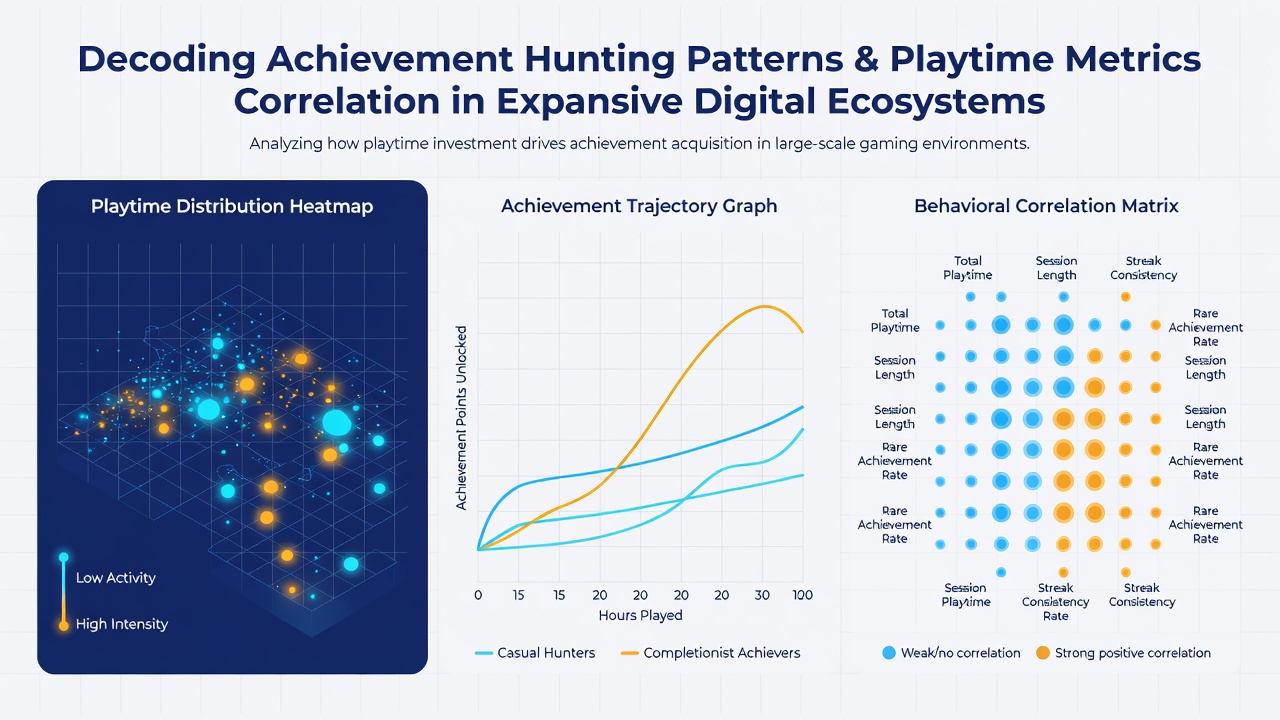
Figures released by Australian trade organizations tracking digital entertainment consumption further confirm that the steepest increases in playtime occur once players surpass the halfway mark on achievement lists, suggesting a momentum effect where remaining goals become more compelling. Those who've studied session length distributions note shorter but more frequent logins during late-stage hunting phases, as participants return specifically to chase time-sensitive or weather-dependent objectives. Such behaviors produce distinct spikes in daily active user metrics without necessarily raising peak concurrent player counts.
Regional Variations and Platform Influences
North American server data tends to show higher overall playtime multipliers tied to achievement hunting than European counterparts, possibly due to differences in time zone overlap that affect group-based objectives. Meanwhile, reports from Asian markets highlight mobile-first expansive worlds where achievement systems integrate with daily login rewards, producing steadier but smaller daily playtime additions. Researchers at institutions in the United Kingdom have begun cross-referencing these regional datasets to isolate platform-specific factors such as controller versus touch input that subtly shift hunting efficiency.
Community-driven tools that overlay achievement trackers on in-game maps have gained traction in 2026, and usage statistics indicate that players employing such overlays log twenty-five percent more hours on average before declaring a title complete. These tools do not alter core game systems yet facilitate more systematic approaches that extend engagement windows measurably.
Conclusion
Telemetry across expansive digital worlds continues to demonstrate consistent links between achievement hunting density and elevated playtime metrics, with regional and platform nuances shaping the exact strength of those connections. Continued monitoring through 2026 and beyond will likely refine these models as new titles introduce evolving objective structures and cross-platform persistence features.